Hemostatic Gauzes: QuikClot, ChitoSAM, and Packing Alternatives
Share
When controlling severe, life-threatening bleeding, situations often arise where a tourniquet cannot be applied. This is particularly relevant for injuries in junctional areas—neck, armpit, or groin zones where major blood vessels lie deep within tissue. Hemostatic dressings were developed to manage such injuries; they not only physically pack the wound cavity, but also chemically promote blood clotting.
Bleeding Control and the Importance of Wound Packing
Bleeding from major arteries can cause death within minutes. For deep puncture, laceration, or gunshot wounds, external pressure alone is inadequate because the damaged vessel bleeds into the surrounding tissue. Wound packing is the process in which specialized gauze or a hemostatic dressing is packed directly into the wound cavity to apply direct mechanical pressure to the bleeding source.
Before initiating any medical actions, you must ensure that professional help has been summoned—always call 112 (the emergency response number in Lithuania and Europe). Until medical personnel arrive, your task is to stop massive bleeding and maintain the casualty's vital functions. Choosing the right packing tool and applying proper technique are critical elements of this process.
How Do Hemostatic Agents Work?
Standard cotton gauze stops bleeding purely through mechanical pressure and blood absorption. Hemostatic dressings act via a dual mechanism. They are impregnated with special active agents that react with blood to accelerate the natural clotting cascade.
Different manufacturers use different hemostatic agents. In modern tactical medicine, the two dominant active ingredients are kaolin and chitosan. Both materials are widely used by military forces and emergency service personnel. When choosing a product for your first aid kit, it is helpful to understand their mechanisms of action and differences.
QuikClot Combat Gauze: Kaolin-Based Technology
One of the most recognized products featured in TCCC (Tactical Combat Casualty Care) guidelines is QuikClot Combat Gauze hemostatic dressing. The active agent in this gauze is kaolin—a natural, inert mineral (aluminum silicate).
Kaolin directly activates Factor XII of the human clotting cascade. This triggers a rapid chain reaction that forms a solid blood clot within minutes. Unlike some older-generation hemostatic agents, kaolin produces no exothermic reaction upon contact, so it will not burn surrounding tissue.
ChitoSAM: Chitosan-Based Dressings
Another popular and effective alternative is chitosan-based dressings, such as ChitoSAM™ 100 hemostatic dressing. Chitosan is a biopolymer derived from crustacean shells (chitin). According to manufacturers, allergens are removed during processing, allowing chitosan dressings to be safely used even by individuals allergic to shellfish.
Chitosan acts differently than kaolin. It is positively charged and attracts negatively charged red blood cells. Upon contact with blood, chitosan swells, turns into a gel-like mass, and physically "locks" the damaged site by creating a strong, sticky clot. Manufacturers note that this mechanism operates independently of the body's natural clotting factors, making it effective even when clotting is impaired, such as in hypothermic casualties.
Packing Gauzes Without Hemostatic Agents
Although hemostatic dressings are superior for severe hemorrhage, standard packing gauzes remain an essential first aid tool. For instance, compressed TyTek Medical EZ-Gauze wound packing gauze is a Z-folded gauze designed to efficiently fill the wound cavity. Alternatively, 6:8 Medical packing gauze without hemostatic agent can also be used.
Standard packing gauze controls bleeding through pressure alone, making it especially important to pack the wound tightly and maintain pressure longer. Such gauzes are also suitable for training—it is valuable to practice wound packing techniques before needing them in a real scenario.
Comparison of Hemostatic and Standard Gauzes
| Feature | QuikClot Combat Gauze | ChitoSAM 100 | Non-hemostatic Packing Gauze |
|---|---|---|---|
| Active Agent | Kaolin | Chitosan | None |
| Mechanism of Action | Promotes natural blood clotting | Forms a sticky gel that seals blood | Pure mechanical pressure |
| Indications | Deep and junctional wounds | Deep and junctional wounds | When hemostatics are unavailable; training |
Practical Checklist: Proper Wound Packing Technique
Even the most expensive hemostatic dressing will not be effective if applied incorrectly. Wound packing is an aggressive, painful procedure for the patient, but a life-saving one. Wearing protective gloves before starting is recommended.
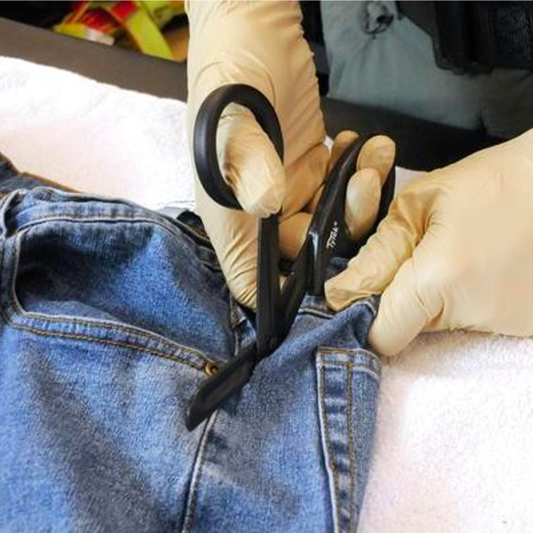
- Identify the source of bleeding: Expose the wound. If the cavity is full of blood, quickly sweep it out with fingers or plain gauze to visually locate the exact site of arterial pulsing.
- Direct pressure: Apply direct finger pressure onto the damaged blood vessel at the base of the wound. This stops active bleeding while you prepare the dressing.
- Feeding the gauze: Open the dressing package. The Z-fold packaging allows you to feed the gauze gradually without tangling or dropping it on the ground.
- Packing: Maintain pressure with one finger while using a finger of your other hand to pack the gauze deep into the wound, directly against the bleeding vessel. Pack tightly and deeply.
- Filling the cavity: Continue packing until the wound cavity is completely filled and gauze begins to rise above skin level. If extra gauze remains, tear it off or leave it on top.
- Holding pressure: Once packed, apply firm direct pressure with both hands. When using a hemostatic dressing, hold pressure for the time specified on the package (at least 3 minutes for QuikClot Combat Gauze). When using standard packing gauze, hold pressure longer and ensure bleeding has stopped.
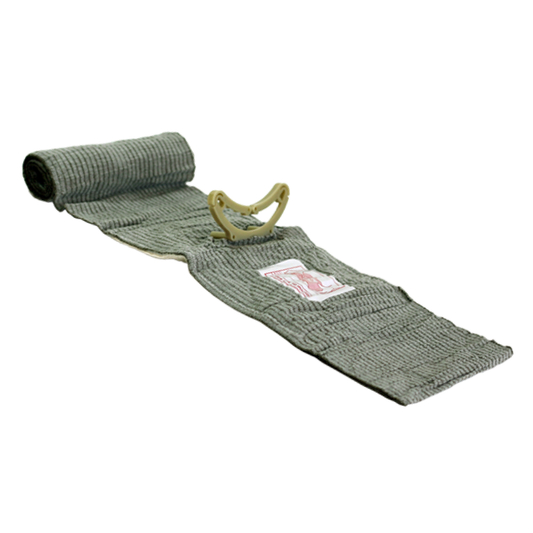
- Securing: After the required time, slowly release pressure to confirm bleeding has not resumed. Place an Israeli compression bandage over the top to secure the packing and maintain pressure during evacuation.
If bleeding resumes and breaks through the packing after holding pressure, standard guidance recommends leaving the initial packing in place, adding a second gauze (hemostatic or standard) to pack further, and applying strong direct pressure again. For detailed guidance on decision-making, see Bleeding Control: Pressure, Packing, or Tourniquet.
Want to learn how to do this in practice? We organize tactical medicine training—more info at mokymai@parakomanai.lt.
Didn't find the item you need? Write to us at parduotuve@parakomanai.lt—we'll help you out.
Sources
- Stop the Bleed: stopthebleed.org
- Deployed Medicine (TCCC Guidelines): deployedmedicine.com
- Emergency Response Centre (Lithuania): 112.lt