Where to Wear Your Tourniquet and IFAK: Belt, Vest, Leg, or Car
Share
Carrying medical gear is only the first part of preparedness. In a critical situation involving life-threatening arterial bleeding, time becomes the decisive factor. If a tourniquet or first aid kit is stowed deep inside a backpack under other items, the casualty may lose consciousness before you even manage to pull it out. For this reason, the placement of the tourniquet and first aid kit on your gear or clothing must be precisely planned.
Critical Importance of Tourniquet and IFAK Accessibility
Massive arterial hemorrhage can lead to fatal blood loss in a very short period. A tourniquet must be applied as quickly as possible – every second counts. Therefore, the mounting location of the tourniquet must guarantee swift extraction.
An essential requirement is that the tourniquet and individual first aid kit (IFAK) must be easily reachable with both hands (both left and right). If one arm is injured or pinned down, the casualty must be able to retrieve the tourniquet with the remaining free hand. It is also important to remember that in an emergency, professional help must be summoned immediately by calling 112 (Lithuania's emergency line).
Mounting on a Tactical Belt and Plate Carrier
In military, law enforcement, and riflemen equipment, two primary mounting locations are most commonly used: the tactical belt and the plate carrier.
The belt and plate carrier each have distinct features:
- Tactical Belt: Mounting a tourniquet or IFAK on the belt (lower back or side) keeps the first aid kit on your body even if the plate carrier is removed. A dedicated tourniquet pouch securely retains the device while protecting it from dirt and UV radiation. A tourniquet pouch with MOLLE system and carabiner is also used, which additionally holds tactical shears.
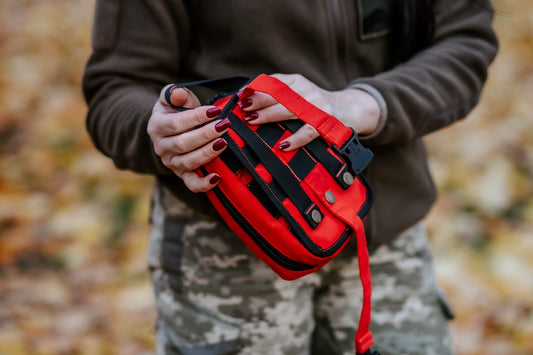
- Plate Carrier: Mounting on the chest or abdomen area provides excellent visibility and accessibility with both hands. An IFAK First Aid Pouch featuring a rip-away design is installed here. This allows peeling the first aid pouch off its hook-and-loop base in a single motion to place it alongside the casualty.
Drop-Leg (Thigh-Mounted) Pouches
Another popular choice, particularly among special forces officers or drivers, is drop-leg systems. A thigh-mounted First Aid Pouch is utilized in this position.
The advantage of a drop-leg pouch is that it leaves the torso and chest area completely unencumbered, making sitting inside a vehicle comfortable. The kit is within easy reach of a lowered hand. However, this method has drawbacks: during long foot marches, weight attached to the leg fatigues muscles faster, and while moving through thick brush or mud, the pouch can snag on branches or get soiled.
Storing Medical Gear in a Vehicle
In civil defense and everyday life, carrying a tourniquet and IFAK on one's body is not always practical. Consequently, a large portion of necessary equipment is kept inside vehicles. It is vital to know that a first aid kit stowed in a standard trunk under the spare tire will be difficult to access during a motor vehicle accident.
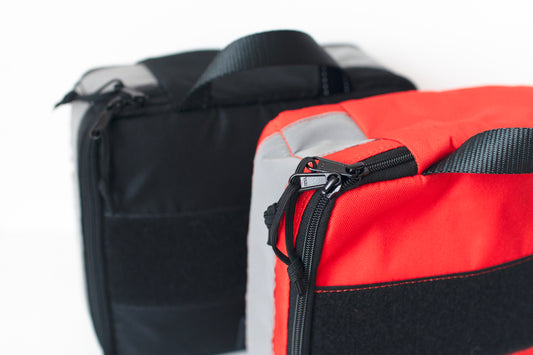
Vehicle gear must be secured inside the cabin. A car first aid kit pouch should be used for this – keep it in the cabin where both driver and passengers can reach it. Additionally, a reflective tourniquet pouch can be mounted in a visible spot, making it easy to spot under flashlight illumination at night.
Mounting Locations Comparison Table
| Mounting Location | Ambidextrous Reachability | Ergonomics (Sitting / Moving) | Environmental Protection | Primary Purpose |
|---|---|---|---|---|
| Chest / Plate Carrier | Very good | Moderate (may hinder prone positioning) | Good | Tactical operations, riflemen, military |
| Tactical Belt | Good | Good | Good (when using an enclosed pouch) | Everyday loadout, law enforcement |
| Thigh (Drop-leg) | Good (same-side hand) | Excellent when seated, lower on long marches | Moderate (higher exposure to dirt) | Drivers, officers, vehicle crews |
| Vehicle Cabin | Good for all passengers | Does not obstruct movement | Very good | Civilian use, road trips, auto accidents |
Practical Checklist: Equipment Layout Rules
When planning tourniquet and IFAK positioning, adhere to these principles:
- Staging and Preparation: A tourniquet inside a pouch must be removed from its factory plastic wrapping and folded into a staged (ready) position. Never keep a tourniquet sealed in its original packaging. You can learn more about tourniquet models by reading our tourniquet selection guide.
- Standardization Across the Team: If operating in a group or unit, all members' tourniquets and IFAK pouches must be mounted in identical locations. Do not store your kit in a different position than your teammates.
- Marking: A medical pouch must be clearly marked with a red cross, TCCC, or "MED" patch so that a responder can immediately distinguish it from ammunition pouches. Detailed info on contents can be found in our overview of IFAK composition.
- Mandatory Vehicle Requirements: A car first aid kit must comply with legal requirements established by Lithuanian regulations. Read about this in our guide on car first aid kit requirements in Lithuania.
Want to learn how to do this in practice? We organize tactical medicine training – for more information contact mokymai@parakomanai.lt.
Didn't find the gear you need? Drop us a line at parduotuve@parakomanai.lt – we'll help you out.
Sources
- Deployed Medicine (TCCC Guidelines): deployedmedicine.com
- NAEMT: naemt.org
- Lithuanian Emergency Preparedness Portal: lt72.lt
- General Emergency Response Centre of Lithuania: 112.lt